
MCTS Optimizer
The MCTS optimizer uses trained latency models to search over workload assignments. Instead of asking which database is best in general, it asks which database should serve each workload query when latency and storage cost are considered together.
This page starts after latency models already exist. The optimizer can receive latency through a callback, or through a precomputed query/database latency matrix. Storage cost is still optional and callback-based.
A workload assignment grows combinatorially. If there are N workload queries and M feasible databases, a simple query-to-database assignment space can have up to M^N states.
The decisions also interact. Sending one query to MongoDB may look best for latency, but sending several related queries there may require storing the same physical collections or documents. Splitting related queries across systems can reduce latency for individual queries while increasing storage cost.
Monte Carlo Tree Search is useful here because it does not require exhaustive enumeration. It incrementally explores promising local changes while still occasionally trying less visited alternatives.
The generic optimizer lives in:
src/search/mcts.py
The main data objects are:
| Object | Meaning |
|---|---|
WorkloadQuery |
A logical query with an id, weight, optional payload, feasible database ids, and storage item ids. |
DatabaseInstance |
A candidate database instance. |
AssignmentConditions |
Optional user-supplied required and forbidden query/database assignments. |
PrecomputedLatencyEstimator |
A validated lookup table for query/database latency estimates. |
State |
A tuple of database ids, one for each workload query. |
ReassignQuery |
A local action that moves one query from one database to another. |
OptimizationResult |
The initial assignment, best assignment, cost breakdown, iteration count, and search trace. |
The order of a state tuple follows the order of the workload query list. For example, with three queries:
("postgres/edbt-3", "mongo/edbt-3", "neo4j/edbt-3")
means the first query is assigned to PostgreSQL, the second to MongoDB, and the third to Neo4j.
Every state must assign every query exactly once. A query can be restricted to specific databases with feasible_database_ids, or through a custom can_execute callback.
The optimizer can also receive AssignmentConditions:
must_assign: query ids that must be assigned to one specific database id,must_not_assign: query ids that must not be assigned to one or more database ids.
These conditions are combined with the existing feasibility rules. If a query is forced to a database, all other databases are infeasible for that query. If a query forbids a database, that specific pair is infeasible. The optimizer validates unknown ids, contradictory conditions, and queries that have no feasible database after conditions are applied.
If no initial assignment is provided, the optimizer uses the first feasible database for each query. This initial state becomes the baseline for reporting improvement and computing rewards.
The optimizer validates:
- query ids are unique,
- database ids are unique,
- query weights are finite and non-negative,
- every query has at least one feasible database,
- cost estimates are finite and non-negative.
An action is a single reassignment:
move query q from database A to database B
In code, this is ReassignQuery. The optimizer only generates actions that move a query to a feasible database. Applying one action creates a neighboring state.
This local-action design keeps the branching factor manageable. Large changes are represented as a sequence of small reassignments.
The optimizer computes a raw latency component and a raw storage component. Then it combines them with user-supplied weights:
total_cost =
  latency_cost_weight * latency_cost
  + storage_cost_weight * storage_cost
Latency cost is query-weighted:
latency_cost = sum(query.weight * predicted_latency(query, assigned_database))
Storage cost is charged once per physical storage item per assigned database. If two queries assigned to the same database need the same storage item, that item is counted once. If related queries are split across databases, the required physical items can be counted separately for each database.
This is the mechanism that lets the optimizer trade off fast per-query placements against storage duplication.
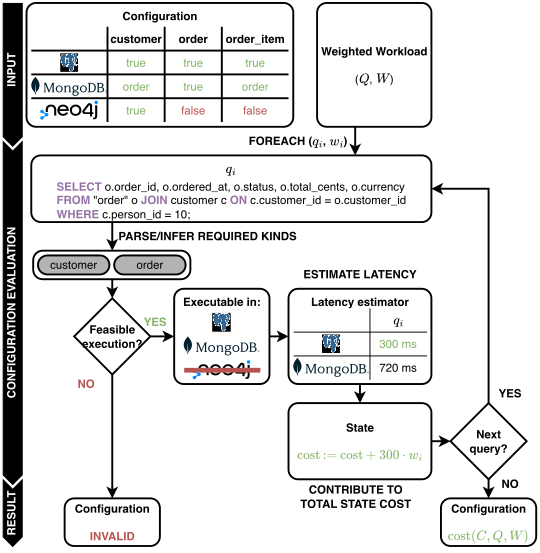
Each MCTS iteration follows the usual phases.
Selection walks from the root through already-expanded children using a UCT-like score:
average_reward + exploration_constant * exploration_term
Expansion chooses one unexpanded admissible reassignment and creates the child state.
Evaluation computes the state’s weighted cost by calling the latency and storage estimators. The reward is based on the initial baseline cost divided by the current cost, so lower cost gives higher reward.
Backpropagation adds the reward to every node on the selected path and updates edge visit counts.
The optimizer caches latency estimates, storage estimates, state costs, and state rewards. This matters because the same state can be reached through different reassignment orders. When latency_estimates is passed to MCTSOptimizer, the optimizer validates that every feasible query/database pair has a finite, non-negative precomputed latency before the search starts.
Assignment conditions reduce the set of feasible pairs, so precomputed latency matrices only need to contain rows for pairs that the optimizer may actually evaluate.
The concrete EDBT runner is:
src/scripts/mcts/run_edbt.py
It builds semantic query bundles from the EDBT mcts-* templates. Each bundle represents one logical workload query and contains driver-specific versions of that query:
- SQL for PostgreSQL,
- a
MongoQueryfor MongoDB, - Cypher for Neo4j.
The current template set is:
mcts-0 ... mcts-23
The runner creates three candidate database instances for the selected scale:
postgres/edbt-{scale}
mongo/edbt-{scale}
neo4j/edbt-{scale}
The runner supports two latency workflows:
- live flat-model prediction, where each candidate latency is estimated by loading the driver-specific flat model, fetching a non-executing plan, and predicting from that plan,
- offline MCTS, where the runner loads a precomputed latency matrix and never connects to the database instances during search.
The EDBT runner uses a lightweight storage-cost model based on expected record counts from the EDBT data generator and configurable per-driver multipliers.
Storage items are namespaced by driver:
postgres:order
mongo:order
neo4j:Order
neo4j:HAS_ITEM
When a query is assigned to a database, only storage ids matching that database’s driver contribute to the storage cost. This lets one semantic query refer to the relevant physical tables, collections, labels, or relationships for each candidate database system.
The default storage multipliers are defined in run_edbt.py and can be overridden from the command line.
Before running the EDBT optimizer, the selected scale should be populated in all three databases, and the flat models referenced by the command should exist. MongoDB also needs cached global field statistics for prediction; these are usually created during MongoDB flat dataset creation. If they are missing, the runner can collect them with --collect-mongo-global-stats.
Example:
python -m scripts.mcts.run_edbt \
  --scale 3 \
  --iterations 20000 \
  --instances-per-template 1 \
  --postgres-model-id postgres/edbt-2-3-flat-rf \
  --mongo-model-id mongo/tpch-2-flat-xgb-log \
  --neo4j-model-id neo4j/tpch-2-flat-rf \
  --latency-cost-weight 1 \
  --storage-cost-weight 0.3
Useful flags:
| Flag | Meaning |
|---|---|
--scale |
EDBT scale used for query generation and database ids. |
--iterations |
Number of MCTS iterations. |
--instances-per-template |
Number of parameter instances per mcts-* template. |
--seed |
Random seed for reproducible search choices. |
--latency-cost-weight |
Weight applied to the latency component. |
--storage-cost-weight |
Weight applied to the storage component. |
--postgres-model-id |
PostgreSQL flat model id. |
--mongo-model-id |
MongoDB flat model id. |
--neo4j-model-id |
Neo4j flat model id. |
--conditions-file |
Optional JSON file with required and forbidden query/database assignments. |
--collect-mongo-global-stats |
Collect MongoDB field stats if no cache exists. |
--describe-only |
Print setup information without running MCTS. |
--random-start |
Flag to make the initial assignment of queries to databases random. |
Use --describe-only to inspect the workload, model ids, storage multipliers, and full-union storage baselines before paying the cost of prediction and search:
python -m scripts.mcts.run_edbt --scale 3 --describe-only
For database-free MCTS runs, first precompute the latency matrix:
python -m scripts.mcts.precompute_edbt_latencies \
  --scale 3 \
  --instances-per-template 1 \
  --postgres-model-id postgres/edbt-2-3-flat-rf \
  --mongo-model-id mongo/tpch-2-flat-xgb-log \
  --neo4j-model-id neo4j/tpch-2-flat-rf
By default, this writes:
data/cache/mcts/edbt-3/latency-estimates-1.jsonl
Use --output to choose a different path. The precompute step uses the same flat-model prediction path as live MCTS, so it may need database access to fetch plans. Once the file exists, MCTS can run without database access:
python -m scripts.mcts.run_edbt \
  --scale 3 \
  --iterations 40000 \
  --instances-per-template 1 \
  --latency-estimates data/cache/mcts/edbt-3/latency-estimates-1.jsonl \
  --latency-cost-weight 1 \
  --storage-cost-weight 0.3 \
  --random-start
When --latency-estimates is provided, run_edbt ignores the model-id flags for the MCTS run. It still builds the same semantic workload and storage cost model, validates that the matrix matches the selected scale and instance count, and checks that every condition-feasible query/database pair has exactly one valid latency.
The precompute script still writes a full matrix for all query/database pairs. Conditions are applied only when running MCTS.
Both run_edbt and the synthetic example runner accept an optional JSON conditions file:
python -m scripts.mcts.run_edbt \
  --scale 3 \
  --iterations 20000 \
  --latency-estimates data/cache/mcts/edbt-3/latency-estimates-1.jsonl \
  --conditions-file /tmp/mcts-conditions.json
The file has two optional top-level keys:
{
  "must_assign": {
    "mcts-0:0": "postgres"
  },
  "must_not_assign": {
    "mcts-1:0": ["mongo", "neo4j/edbt-3"]
  }
}
must_assign maps a query id to the database it must use. must_not_assign maps a query id to a list of databases it must not use. If no --conditions-file is supplied, MCTS runs exactly as before.
For EDBT, query ids are semantic workload ids such as mcts-0:0. Database refs may be full database ids like postgres/edbt-3, or driver aliases:
postgres
mongo
neo4j
Aliases are normalized using the selected --scale, so postgres becomes postgres/edbt-3 when --scale 3.
The synthetic example runner uses exact database ids:
{
  "must_assign": {
    "q01": "neo4j-graph"
  },
  "must_not_assign": {
    "q02": ["mongo-cluster"]
  }
}
The latency matrix is JSONL. The first row is a header with:
format,format_version,schema,scale,instances_per_template,query_ids,database_ids,latency_unit,source_metadata.
Each following row contains:
query_id,database_id,latency_ms,- optional
source_query_id.
The setup section prints:
- scale,
- number of templates,
- instances per template,
- workload query count,
- iteration count,
- latency and storage weights,
- model ids or the latency-estimates path,
- storage multipliers,
- full-union storage baseline by database,
- semantic workload titles and weights.
The result section prints:
- iterations completed,
- number of unique states visited,
- initial weighted cost,
- best weighted cost,
- latency and storage breakdowns,
- best reward,
- assignment conditions, when a conditions file was supplied.
Conditions are printed with normalized database ids:
Assignment conditions:
  must assign:
    mcts-0:0 -> postgres/edbt-3
  must not assign:
    mcts-1:0 -> mongo/edbt-3
The best assignment section maps every semantic workload query to a database:
mcts-3:0 weight=1: mongo/edbt-3 (12.34 ms, storage=order, product)
For each query, the runner also prints predicted latency on every candidate database. The selected database is marked with *.
The final section lists stored physical items by database and their storage cost. This is the easiest place to see whether the optimizer concentrated related workload pieces in one system or spread them across systems for latency.
There is also a synthetic example that does not require trained database models:
python -m scripts.mcts.run_example --iterations 20000 --storage-cost-weight 0.3
It accepts the same --conditions-file shape, but database ids must match the example’s database ids such as postgres-primary, mongo-cluster, neo4j-graph, and postgres-analytics.
It uses generated latency and storage callbacks to demonstrate the optimizer’s behavior. Use it for understanding the generic search mechanics; use run_edbt for the repository’s real cross-database EDBT workflow.